

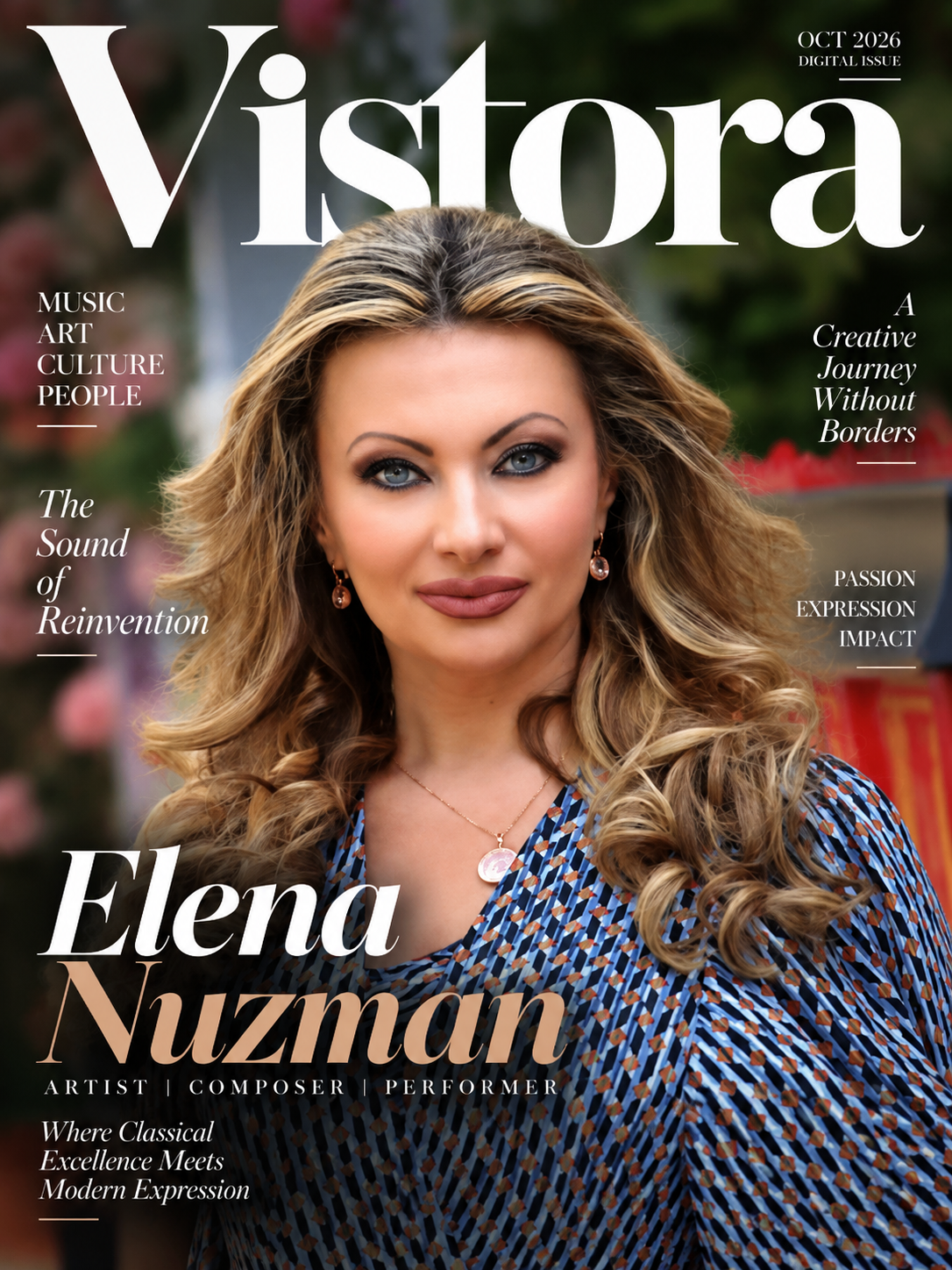
The Woman Behind the Music
In a world where artists are often encouraged to find a signature style and remain within its boundaries, Elena Nuzman has chosen a different path. Her career reflects a willingness to explore, experiment, and embrace the many possibilities of musical expression. Equally connected to the discipline of classical piano and the emotional intensity of contemporary music, she has built an artistic identity that combines technical mastery with a distinctly personal approach to performance.
As a concert pianist, vocalist, and composer, Nuzman represents a generation of musicians who understand that creativity is not confined to a single genre. Her work moves between classical compositions, pop melodies, and rock interpretations, creating a musical landscape in which different influences can coexist naturally.
Behind this versatility lies a story of early talent, rigorous education, international experiences, and a continuous desire to grow. Her journey demonstrates that artistic development is rarely a finished process. Instead, it is an ongoing conversation between experience, ambition, and the courage to discover something new.
Where It All Began
Nuzman’s musical story began in Moldova, where she was born into a family of professional musicians. Growing up in a household surrounded by music gave her an early familiarity with instruments, melodies, and the discipline associated with a musical life.
Her natural ability became apparent at an extraordinary age. At just two years old, she was already reproducing melodies on the piano by ear, showing an instinctive understanding of musical patterns. What might have appeared to be a childhood fascination soon developed into something much more significant.
At seven, she entered a prestigious music academy for gifted students. This marked the beginning of a demanding period of formal training that would establish the foundations of her professional career.
Classical music requires patience, precision, and an understanding of details that are not always immediately apparent to the listener. Every phrase, pause, and change in dynamics contributes to the character of a performance. Through years of study, Nuzman learned to appreciate how technical discipline and emotional interpretation work together.
These early lessons would remain important throughout her career, even as she began exploring musical styles beyond the classical repertoire.
Learning Through Different Cultures
Music became a passport to experiences far beyond her birthplace. Nuzman’s journey took her through Russia, France, the United States, Israel, and Canada, exposing her to different cultural environments and expanding her understanding of artistic expression.
Each new setting offered an opportunity to observe how music connects people who may otherwise have very different backgrounds. Although musical traditions vary, the emotions expressed through melody, harmony, and rhythm can often be understood without explanation.
Her academic development continued at the Robert Schumann University of Music in Düsseldorf, Germany, where she completed a master’s degree in concert piano. The experience strengthened her technical abilities and deepened her understanding of the classical tradition.
For Nuzman, education was more than the acquisition of qualifications. It was a process of learning how to listen, interpret, and communicate through music. That foundation would later help her navigate the demands of contemporary performance while maintaining the precision expected of a classically trained pianist.
Finding a New Voice
Although the piano had long been central to her musical identity, Nuzman’s career took an unexpected direction when she began exploring vocal performance.
A participation in a vocal competition became a defining moment. Winning first prize in the Rock-Pop category revealed a new creative opportunity and encouraged her to explore a different relationship with audiences.
Singing required her to approach musical interpretation from another perspective. While piano performance involves communicating emotion through an instrument, vocal performance introduces the human voice as a direct and personal means of expression.
With a reported four-octave vocal range, Nuzman developed a style that combines musical control with expressive intensity. Her classical background provided a strong understanding of phrasing and dynamics, while rock and pop allowed her to embrace a more contemporary performance language.
Her debut album, I Believe In You, introduced audiences to this crossover approach. Blending emotional ballads with rock influences, the record demonstrated her ability to move beyond conventional genre distinctions.
The album entered the German Newcomer Charts and remained in the Top 10 for several weeks. Her interpretation of Whitesnake’s classic song “Here I Go Again” also reached large audiences, including those attending New Year’s Eve celebrations at Berlin’s Brandenburg Gate.
These experiences helped establish her presence as a performer whose musical identity extended beyond the concert hall.
Redefining the Relationship Between Classical and Pop

With her second album, Liebestraum, Nuzman explored the relationship between classical music and contemporary songwriting more directly.
Inspired by the Romantic era, the project drew upon the emotional depth and harmonic richness of classical piano compositions while incorporating elements of modern pop. Rather than presenting these influences as separate traditions, she approached them as complementary forms of expression.
The result reflected an interest in musical reinvention. Classical music provided structure and depth, while contemporary arrangements created opportunities for accessibility and a different kind of audience connection.
The project also reflected her development as a composer. By writing many of the songs herself, Nuzman expanded her creative role beyond interpretation, bringing her own ideas and perspectives into the music.
The title track surpassed four million views on YouTube and received the IMPALA Silver Award, marking an important achievement in her career.
More significantly, the project illustrated how an artist can respect musical traditions while allowing them to evolve. For Nuzman, innovation does not require rejecting the past. It means finding new ways to make its emotional power relevant to the present.
Returning to Her Musical Roots
In 2025, Nuzman released My Piano And I, an album that revisits the instrument that first shaped her artistic development.
The project brings together celebrated songs, new compositions, and English versions of selected works. It reflects a career in which the piano has remained a constant presence, even as her interests have expanded into singing, songwriting, and contemporary performance.
The album’s title suggests a personal relationship built over many years. The piano is not simply an instrument she performs on. It represents the beginning of her musical education, the discipline that shaped her abilities, and the creative foundation that continues to inform her work.
Returning to that foundation after years of experimentation offers an opportunity to approach familiar musical ideas with a different perspective. Experience changes the way an artist listens, interprets, and responds to a composition.
Nuzman’s continuing connection with the piano reflects this process of development, in which the familiar can remain meaningful while offering new possibilities for expression.
The Meaning of Artistic Independence
One of the most interesting aspects of Nuzman’s career is her willingness to move between different creative identities without treating them as competing ambitions.
The concert pianist, the vocalist, and the composer are different expressions of the same artistic curiosity. Each role offers a distinct way to explore music, communicate emotion, and connect with an audience.
Her journey also highlights the importance of preparation behind creative freedom. Experimentation becomes more meaningful when supported by a strong technical foundation. The discipline developed through classical training gives her the tools to approach different styles with confidence.
At the same time, the willingness to explore unfamiliar territory prevents technical mastery from becoming a limitation. Instead of remaining within the boundaries of what she already knows, Nuzman continues to investigate what else her musical abilities can achieve.
This balance between discipline and independence has become an important part of her artistic identity.
An Ongoing Story of Creativity
Elena Nuzman’s journey is a reminder that an artist’s identity need not remain fixed. From her childhood in Moldova to advanced musical studies in Germany, from classical piano to rock and pop, and from performing established works to creating original compositions, each chapter has contributed to a broader understanding of her craft.
Her career reflects a commitment to continued development rather than a desire to remain within a single definition of success. Musical traditions provide inspiration, education provides structure, and personal experience offers new perspectives through which creativity can develop.
For Vistora, Nuzman’s story represents the value of individuality and the importance of pursuing a personal vision with dedication. Her journey shows that technical excellence and creative freedom can strengthen one another, allowing an artist to explore new directions without losing the qualities that first defined her.
As she continues to develop her work, the relationship between classical refinement and contemporary expression remains central to her musical world.
Elena Nuzman is not simply a pianist who sings or a vocalist who composes. She is an artist whose experiences across instruments, genres, and cultures have shaped a distinctive approach to music.
Her story continues to evolve, guided by the same curiosity that first drew her to the piano as a child: the belief that every melody holds the possibility of discovering something new.